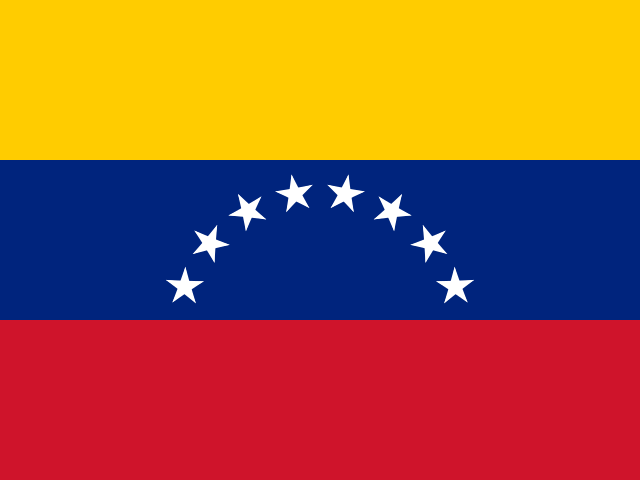
 Trademarks in Venezuela
Competent Authority
The national government agency responsible for industrial property administration and trademark registrations in Venezuela is the Autonomous Service of Intellectual Property (Servicio Autónomo de la Propiedad Intelectual - SAPI), operating under the Ministry of Popular Power for Commerce. The administrative system is strictly national, governed primarily by the historic Industrial Property Law of 1956. The official working language for all filings, documentation, and proceedings is Spanish.
International Treaties
Venezuela is a member of the Paris Convention for the Protection of Industrial Property. However, Venezuela is not a member of the Madrid System (neither the Madrid Agreement nor the Madrid Protocol); therefore, international registrations via the Madrid route cannot designate Venezuela, and all applications must be filed directly through national procedures with SAPI.
Who May Apply & Representation
Any natural or legal person, domestic or foreign, may apply for and hold a trademark registration. Foreign applicants or entities not domiciled in Venezuela must be represented by a local authorized industrial property agent or representative. Representation requires a Power of Attorney (POA), which must be notarized and legalized via Apostille (or authenticated through a Venezuelan Consulate). Certified Spanish translations by a local public sworn interpreter are required for all foreign-language documents.
Online Filing & Search Databases
SAPI provides digital processing channels through its electronic platform (WEBPI). Conducting a prior availability and clearance search (phonetic for word marks, graphic and phonetic for logos/mixed marks) using the WEBPI system is a compulsory prerequisite that must be initiated prior to or concurrently with filing.
Protectable Trademark Types
Under Venezuelan law, protectable signs include words, names, figurative elements, mixed marks, logotypes, and commercial slogans, provided they possess distinctiveness. Transliteration or Spanish translation is required for terms expressed in foreign languages or non-Latin alphabets.
Classification System
Venezuela does not utilize the standard international Nice Classification system in its traditional multi-class format; instead, filings operate under local classification structures. Multi-class applications are not permitted; a separate, independent application must be filed for each distinct class of goods or services.
Examination Procedure
SAPI performs an initial formal examination of the application for completeness and legal compliance. If irregularities or defects are identified, SAPI issues an official action (auto) giving the applicant a strict non-extendable or discretionary statutory window (30 business days, subject to administrative extension requests) to respond or rectify the application.
Publication & Opposition
Once an application clears formal examination, it is ordered for publication in SAPI's official intellectual property bulletin/gazette to notify third parties. Any interested party may file an administrative opposition against the application within the statutory opposition window following publication.
Timelines
Due to administrative structures and procedural backlogs, the average timeframe from initial filing to the final grant and issuance of an electronic registration certificate spans 12 to 24 months for uncontested applications, and substantially longer if oppositions or office actions arise.
Duration & Renewal
A trademark registration in Venezuela is valid for 15 years, counted from the date of registration (grant date). Registrations can be renewed indefinitely for successive 15-year periods. Renewal applications must generally be filed within the final 6 months prior to expiration, or during a subsequent 6-month grace period subject to administrative surcharges.
Use Requirements & System Type
Venezuela operates under a first-to-file priority system, meaning registration establishes primary statutory rights regardless of prior use elsewhere. However, registered trademarks are subject to use obligations: a registered trademark is vulnerable to cancellation actions for non-use if it has not been genuinely used in commerce in Venezuela for a continuous period of 2 consecutive years.
Post-Registration Procedures
Recorded changes concerning the owner's name, legal address, corporate structure, assignments (ownership transfers), and licensing agreements must be submitted to SAPI. Recording assignments and trademark licenses is legally mandatory to ensure full public notice and enforceability against third parties.
Legal Remedies & Enforcement
Cancellation actions, invalidity claims, and administrative appeals are managed through SAPI and specialized administrative pathways. Infringement claims, civil damages, and actions against unauthorized commercial use or counterfeiting are pursued through ordinary civil judicial courts, as SAPI's administrative mandate is limited to registration prosecution and opposition handling rather than private infringement litigation.
This article is for informational purposes only and does not constitute legal advice or consultation. To receive personalized and in-depth guidance tailored to your specific situation, we invite you to schedule a consultation.
Talk to a specialist
The first consultation is free. Tell us what you need and when suits you, and we reply to agree a time.
What helps us answer well
- The name or logo you want to protect
- What you sell or offer under it
- The countries where you work or plan to
- Whether you already have an application or registration
- Any date you need to meet