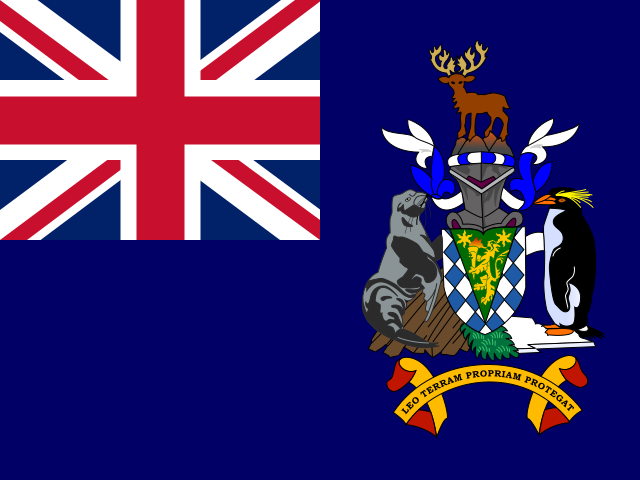
 Trademarks in South Sandwich Islands
Competent Authority
The South Sandwich Islands—administered jointly with South Georgia as the British Overseas Territory of South Georgia and the South Sandwich Islands (SGSSI)—has no permanent civilian population and does not maintain an independent local intellectual property registry or administration office. Trademark protection within the territory is secured entirely through the extension of United Kingdom (UK) trademark rights. The official working language is English.
International Treaties
Because the territory is an overseas territory of the United Kingdom, international treaties ratified by the UK (such as the Paris Convention and the Madrid System via UK designations) encompass the region through the foundational UK registration framework. Designating the United Kingdom through an international application under the Madrid Protocol or registering directly with the UK Intellectual Property Office (UKIPO) forms the basis for territorial extension.
Who May Apply & Representation
Any natural or legal person holding a valid UK trademark registration may secure protection for the territory. Representation requirements mirror those mandated by the UKIPO for primary filings.
Online Filing & Search Databases
There is no local filing portal, search database, or registry office located within the territory. Clearance searches and administrative filings are managed entirely through the UKIPO infrastructure, as local territorial protection relies directly on the status of the parent UK registration.
Protectable Trademark Types
Protectable marks are governed strictly by the standards and classifications of the underlying UK registration, including word marks, figurative signs, shapes, colors, and non-traditional marks accepted by the UKIPO.
Classification System
The Nice Classification system is utilized, matching the multi-class framework established by the underlying UK or international registration extending to the UK.
Examination, Publication & Opposition
Substantive examination, publication, and third-party opposition procedures are handled exclusively by the UKIPO during the prosecution of the parent UK application. There is no independent local opposition procedure or local examination mechanism within the territory.
Timelines
The timeline for securing and enforcing protection runs parallel to the processing time of the parent UK trademark application. Once a UK trademark registration is successfully granted, protection extends to cover the territory.
Official Fees
There are no separate local filing, publication, or grant fees payable to an administrative office within the South Sandwich Islands. All official fees are paid directly to the UKIPO corresponding to the foundational application.
Duration & Renewal
A trademark's protection term matches its parent UK registration—typically 10 years from the original filing date, renewable indefinitely through the UKIPO.
Use Requirements & System Type
Rights depend on the ongoing maintenance, validity, and enforcement of the foundational UK registration. Non-use cancellation actions and legal standing parameters follow UK statutory standards and territorial enforcement protocols.
Post-Registration Procedures
Recordals of assignments, licenses, changes of name, or changes of address must be recorded directly at the UKIPO. Once updated on the UK register, those modifications automatically apply to reflect the corresponding protection status in the territory.
Legal Remedies & Enforcement
Infringement disputes, unauthorized commercial exploitation, and civil remedies are addressed through the legal channels and courts having jurisdiction over the territory, utilizing underlying UK registration certificates as definitive proof of ownership.
This article is for informational purposes only and does not constitute legal advice or consultation. To receive personalized and in-depth guidance tailored to your specific situation, we invite you to schedule a consultation.
Talk to a specialist
The first consultation is free. Tell us what you need and when suits you, and we reply to agree a time.
What helps us answer well
- The name or logo you want to protect
- What you sell or offer under it
- The countries where you work or plan to
- Whether you already have an application or registration
- Any date you need to meet