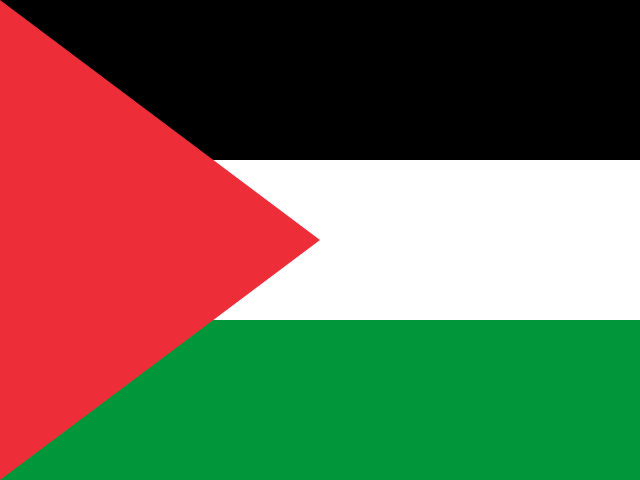
 Trademarks in Palestine
Competent Authority
Trademark registration in Palestine is administered through the Ministry of National Economy. Due to administrative divisions, filings are managed separately across regional registries (such as the Ramallah office for the West Bank and the registry office in Gaza). The official working language is Arabic, and applications are processed under local jurisdictional trademark laws.
International Agreements
Palestine is not a contracting party to the Madrid System; therefore, international registrations cannot be directly extended via Madrid protocols, requiring direct national filings. However, Palestine adheres to general principles under the Paris Convention for the Protection of Industrial Property (allowing priority claims based on prior foreign filings).
Who May Apply
Natural persons, corporate entities, and commercial enterprises engaging in trade or industrial activities may apply. Foreign applicants without a domicile or active business establishment in Palestine must act through a registered representative or legal agent. A signed Power of Attorney (POA) is mandatory and typically requires notarization and consular legalization.
Online Filing and Search
Filings are primarily managed through administrative submission workflows with the Ministry of National Economy. Preliminary availability and clearance searches of regional records can be coordinated via local counsel to check for conflicting prior marks.
Registrable Sign Types
Trademarks may comprise words, names, devices, letters, figures, labels, symbols, or combinations thereof capable of distinguishing goods or services. Non-Arabic characters or foreign words require an accurate Arabic translation and transliteration.
Classification
Palestine follows the international Nice Classification system for the registration of goods and services. Multi-class applications are evaluated according to local administrative capabilities, with specific class-by-class requirements and fee structures.
Examination
The Trademark Registrar conducts a formal administrative examination for completeness, followed by a substantive examination covering absolute grounds for refusal (such as lack of distinctiveness) and relative grounds (conflicts with prior registered marks on the regional database).
Publication and Opposition
Applications that successfully pass examination are published in the official gazette. Any interested third party may file a formal notice of opposition against the registration of the trademark within a statutory window of 3 months from the publication date.
Timelines
An unopposed standard trademark application typically takes an average of 12 to 24 months from initial filing to final registration certificate issuance, depending on regional administrative workflows and publication backlogs.
Protection Duration and Renewal
Unlike jurisdictions utilizing a 10-year term, trademark protection in Palestine is initially valid for 7 years starting from the official application filing date. Registrations can be renewed indefinitely for successive 14-year periods upon submitting a renewal request and paying the requisite fees.
Use Requirements
A registered trademark is vulnerable to cancellation or revocation actions if it is not put to genuine commercial use. Palestine operates primarily on a first-to-file priority framework.
Post-Registration Procedures
Post-registration modifications—including assignments, licensing agreements, changes of registrant name, or changes of address—must be formally recorded with the Ministry of National Economy to ensure full legal validity and enforceability against third parties.
Legal Remedies
Legal remedies include administrative cancellation proceedings, civil infringement lawsuits before competent local courts seeking injunctions and damages, and enforcement measures to intercept counterfeit merchandise.
Country-Specific Risks and Practical Notes
Because Palestine features distinct administrative divisions between the West Bank and Gaza registries (meaning a registration in one does not automatically secure protection in the other), brand owners must carefully evaluate target markets and retain qualified local counsel to manage regional filings, legalization chains, and non-standard 7-year initial validity terms.
This article is for informational purposes only and does not constitute legal advice or consultation. To receive personalized and in-depth guidance tailored to your specific situation, we invite you to schedule a consultation.
Talk to a specialist
The first consultation is free. Tell us what you need and when suits you, and we reply to agree a time.
What helps us answer well
- The name or logo you want to protect
- What you sell or offer under it
- The countries where you work or plan to
- Whether you already have an application or registration
- Any date you need to meet