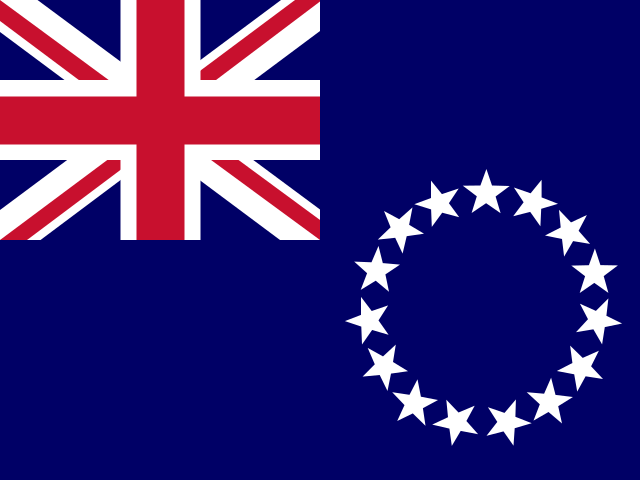
 Trademarks in the Cook Islands
Competent Authority
- Name of Office: Intellectual Property Office of the Cook Islands (IPOCI), operating under the Ministry of Justice
- Working Language: English and Cook Islands Maori
- System Type: National system (governed by the Trade Marks Act 1964 and associated amendments)
International Treaties
- Madrid Protocol: Not a member
- Paris Convention: Member
- Madrid Designation: The Cook Islands cannot be designated through the Madrid System; all applications must be filed directly on a national basis.
Who Can Apply
- Applicants: Natural persons and legal entities.
- Local Representative Requirement: Foreign applicants are required to appoint a local agent or legal representative admitted to practice in the Cook Islands to manage filings and correspondence.
- Power of Attorney: A signed Power of Attorney is generally required for local representation, though standard legalization or notarization is not strictly mandatory unless specifically requested by the Registrar.
Online Filing and Search
- Electronic Filing: Managed primarily through local administrative channels and IPOCI registry procedures rather than a fully automated public e-filing portal.
- Search Database: Public online searchable trademark databases are limited or unavailable; clearance searches are typically conducted via manual registry inspection or through local agent inquiries in Rarotonga.
Protectable Trademark Types
- Types: Word marks, figurative elements, and traditional brand identifiers recognized under national industrial property provisions.
- Translation/Transliteration: Foreign words or non-English characters must be accompanied by certified English translations and transliterations.
Classification
- Classification System: International Classification (Nice Classification).
- Multi-Class Applications: Supported (single applications can cover multiple classes of goods or services).
- Extra Fees: Additional official fees apply per extra class.
Examination
- Examination Scope: Examined ex officio by the Registrar for distinctiveness, legality, and compliance with statutory prohibitions, as well as prior conflicting marks on the local register.
Publication and Opposition
- Opposition Period: Third parties may file an opposition within the statutory opposition window following the publication of the application in the official gazette or registry notices.
- Standing: Any interested third party.
Timelines
- Registration Timeline: Due to manual processing and local review workflows, registrations typically take approximately 6 to 12 months from filing to certificate issuance.
Official Fees
- Specific statutory fee schedules for application filings, extra classes, and renewals are denominated in New Zealand Dollars (NZD) under IPOCI regulations and must be confirmed directly through the registry or local counsel at the time of submission.
Protection Term and Renewal
- Protection Term: 14 years from the date of application (noting historical statutory scheduling under the legacy Trade Marks Act framework), with provisions for subsequent renewals.
- Renewal Grace Period: Successive renewal terms are available, subject to timely filing before expiration.
Use Requirement
- Non-Use Cancellation: Registrations can be vulnerable to non-use cancellation actions if left unutilized for statutory periods.
- System Type: "First-to-file" jurisdiction, incorporating Paris Convention priority rights.
Post-Registration Procedures
- Assignments and Changes: Changes in ownership, corporate name/address updates, and license agreements must be officially recorded with the IPOCI registry to be legally effective against third parties.
Legal Remedies
- Enforcement: Infringement actions, cancellations, and invalidity disputes are handled through the High Court of the Cook Islands.
Country-Specific Risks and Practical Notes
- A notable legislative detail for the Cook Islands is that its standard registration term spans 14 years from the filing date (rather than the international standard of 10 years) under its legacy statutory framework. Additionally, because the jurisdiction operates outside the Madrid System and lacks a comprehensive, self-service online search database, comprehensive clearance searches and direct filings require manual engagement with local agents in Rarotonga.
This article is for informational purposes only and does not constitute legal advice or consultation. To receive personalized and in-depth guidance tailored to your specific situation, we invite you to schedule a consultation.
Talk to a specialist
The first consultation is free. Tell us what you need and when suits you, and we reply to agree a time.
What helps us answer well
- The name or logo you want to protect
- What you sell or offer under it
- The countries where you work or plan to
- Whether you already have an application or registration
- Any date you need to meet