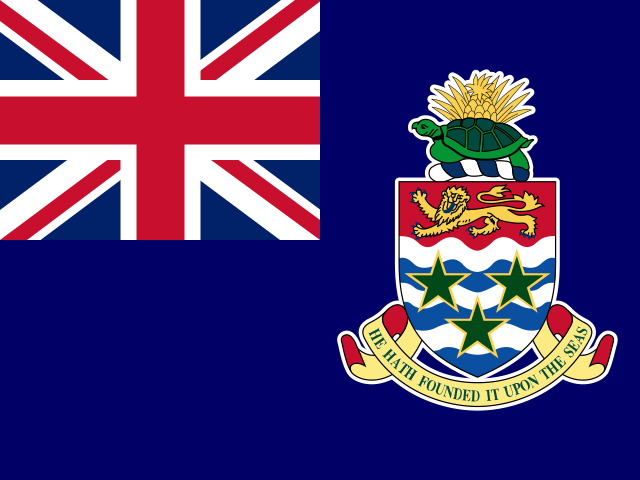
 Trademarks in the Cayman Islands
Competent Authority
- Office Name: Cayman Islands Intellectual Property Office (CIIPO), operating under the General Registry.
- Working Language: English. All official filings and documentation must be submitted in English.
- System Type: Autonomous local national system.
- Important Territorial Note: As a British Overseas Territory, the Cayman Islands is not automatically covered by a United Kingdom national trademark registration, a European Union Trade Mark (EUTM), or an international Madrid Protocol designation. Independent local protection must be secured.
International Treaties
- Paris Convention: Applicable via the United Kingdom’s extension to the Cayman Islands. Priority can be claimed within 6 months from the first foreign filing date.
- Madrid Protocol: Not directly applicable for local designations. Trademarks must be registered directly through the local territorial system administered by CIIPO.
Applicant Eligibility & Representation
- Eligible Applicants: Natural persons and legal entities (both domestic and foreign).
- Local Representation / Agent Requirements:
- All applications, filings, and transactions with CIIPO must be handled by a local Registered Trade Mark Agent authorized in the Cayman Islands. Foreign applicants cannot file pro se or directly without a local agent.
- Power of Attorney (POA): Required. A signed form appointing the registered agent is standard practice.
Online Application & Search Database
- Electronic Filing: Managed via CIIPO’s electronic portals and official filing systems through local registered agents.
- Public Search Database: CIIPO maintains a searchable public register online to check existing records and pending applications.
Registrable Mark Types
- Standard & Non-Traditional Marks: Word marks, figurative/logo designs, phrases, symbols, stylized lettering, 3D shapes, and service marks.
- Translation & Transliteration: Applications incorporating non-English words or non-Latin scripts require an accurate certified English translation and phonetic transliteration.
Classification System
- Classification Standard: Nice Classification system.
- Multi-Class Applications: Allowed. Applicants may include multiple classes under a single application file.
- Class Headings: Class headings are accepted provided the scope of goods and services is clear and precise; specific itemization matching standard Nice terminology is recommended.
- Class Fees: Per-class official fee structure applies.
Examination
- Examination Sequence: CIIPO conducts Formal Examination followed by Substantive Examination (absolute grounds and relative grounds search against prior local records).
- Absolute Grounds: Examined for distinctiveness, generic terms, descriptiveness, deceptiveness, public order, and morality.
- Relative Grounds (Prior Rights): Examined ex officio for likelihood of confusion against prior registered or pending marks in the Cayman Islands.
- Office Actions: Applicants are granted a statutory response period to resolve examiner objections or clarity issues.
Publication & Opposition
- Publication: Once an application clears substantive examination, it is published officially for opposition purposes.
- Opposition Period: A statutory opposition period is provided starting from the publication date.
- Eligible Opponents: Any interested third party claiming prior rights, likelihood of confusion, or statutory grounds of non-registrability.
Timeframe & Acceleration
- Average Timeframe: A smooth, un-opposed trademark application typically takes 6 to 12 months from initial filing to registration certificate issuance.
- Expedited Examination: No formal fast-track fee mechanism is provided; applications are processed sequentially by CIIPO.
Official Fees
(Official administrative fees payable to CIIPO in Cayman Islands Dollars - KYD; fixed peg rate 1 KYD = 1.20 USD)
- Application Filing Fee (First Class): KYD $200.00.
- Additional Class Fee: KYD $75.00 per each additional class.
- Gazette Publication Fee: KYD $50.00.
- Registration Certificate Fee: Included in basic processing fees.
- Annual Maintenance / Renewal Fee: KYD $200.00 for the first class (plus KYD $100.00 for each additional class) due annually to maintain active status.
- Notice of Opposition Fee: KYD $250.00.
Source: Cayman Islands Intellectual Property Office (CIIPO Official Fee Schedule).
Term of Protection & Maintenance
- Protection Period: 10 years calculated from the application filing date (registration date).
- Annual Maintenance Fee Rule: Unique Feature: Unlike most jurisdictions that rely entirely on 10-year lump-sum renewals, the Cayman Islands requires the payment of an annual maintenance fee to keep a trademark registration active. Failure to pay annual fees incurs late penalties and risks removal from the register.
- Renewal Requirements: Renewable for consecutive 10-year terms upon expiration, subject to standard renewal filings.
Use Requirements & First-to-File vs. First-to-Use
- First-to-File System: The Cayman Islands operates primarily on a First-to-File basis for statutory registration. However, common law rights (passing off) protect unregistered marks actively used in local commerce.
- Declaration of Use: Statement of intent or current use requirements apply during application proceedings.
- Non-Use Revocation: A registered trademark is vulnerable to revocation for non-use if it has not been genuinely used in trade within the Cayman Islands for a continuous statutory period.
Post-Registration Transactions
- Assignments & Transfers: Assignments must be recorded with CIIPO via a registered agent to be legally effective against third parties. Official fee: KYD $100.00.
- Licensing: Trademark licenses should be officially recorded with CIIPO. Official fee: KYD $100.00.
- Changes of Name/Address: Must be officially recorded on the register. Official fee: KYD $150.00.
Enforcement & Legal Remedies
- Tribunals & Courts:
- CIIPO: Administrative authority managing applications, renewals, annual maintenance, and recordals.
- Grand Court of the Cayman Islands: Holds exclusive judicial jurisdiction over trademark infringement actions, passing off claims, injunctions, commercial damages, and invalidation lawsuits. English common law principles are applied where local statutes have gaps.
- Well-Known Marks: Recognized and protected under local legal principles and Paris Convention guidelines.
- Customs Enforcement: Brand owners can coordinate with Cayman Islands Customs and Border Control to intercept and detain suspected counterfeit goods at ports of entry.
Country-Specific Risks & Practical Notes
- Mandatory Annual Maintenance Fees: The most critical compliance trap for international brand managers is that the Cayman Islands requires annual fee payments to maintain trademark registrations, alongside standard 10-year renewals. Missing annual fees can lead to inadvertent lapses.
- Local Agent Mandate: Foreign applicants cannot file directly; all communication and submissions must route through a CIIPO-approved Registered Trade Mark Agent.
- No Automatic UK/EU Extension: Brand owners must remember that UK or European Union registrations provide zero direct legal protection in the Cayman Islands without an independent local filing.
This article is for informational purposes only and does not constitute legal advice or consultation. To receive personalized and in-depth guidance tailored to your specific situation, we invite you to schedule a consultation.
Talk to a specialist
The first consultation is free. Tell us what you need and when suits you, and we reply to agree a time.
What helps us answer well
- The name or logo you want to protect
- What you sell or offer under it
- The countries where you work or plan to
- Whether you already have an application or registration
- Any date you need to meet